Kokanee fishing is one of my favorite ways to spend a day on the water. There is nothing quite like finding a school of kokanee, getting your presentation dialed in, and watching multiple rods start bending. Whether you’re fishing with family, introducing someone to the sport, or trying to put more fish in the boat, kokanee fishing offers a challenge that keeps you coming back.
But if you’re new to kokanee fishing, knowing where to start can be overwhelming. There are dodgers, hoochies, spinners, leader lengths, trolling speeds, downriggers, and dozens of color combinations to choose from. You can have a boat full of equipment and still struggle to get a bite if you don’t understand how to put it all together.
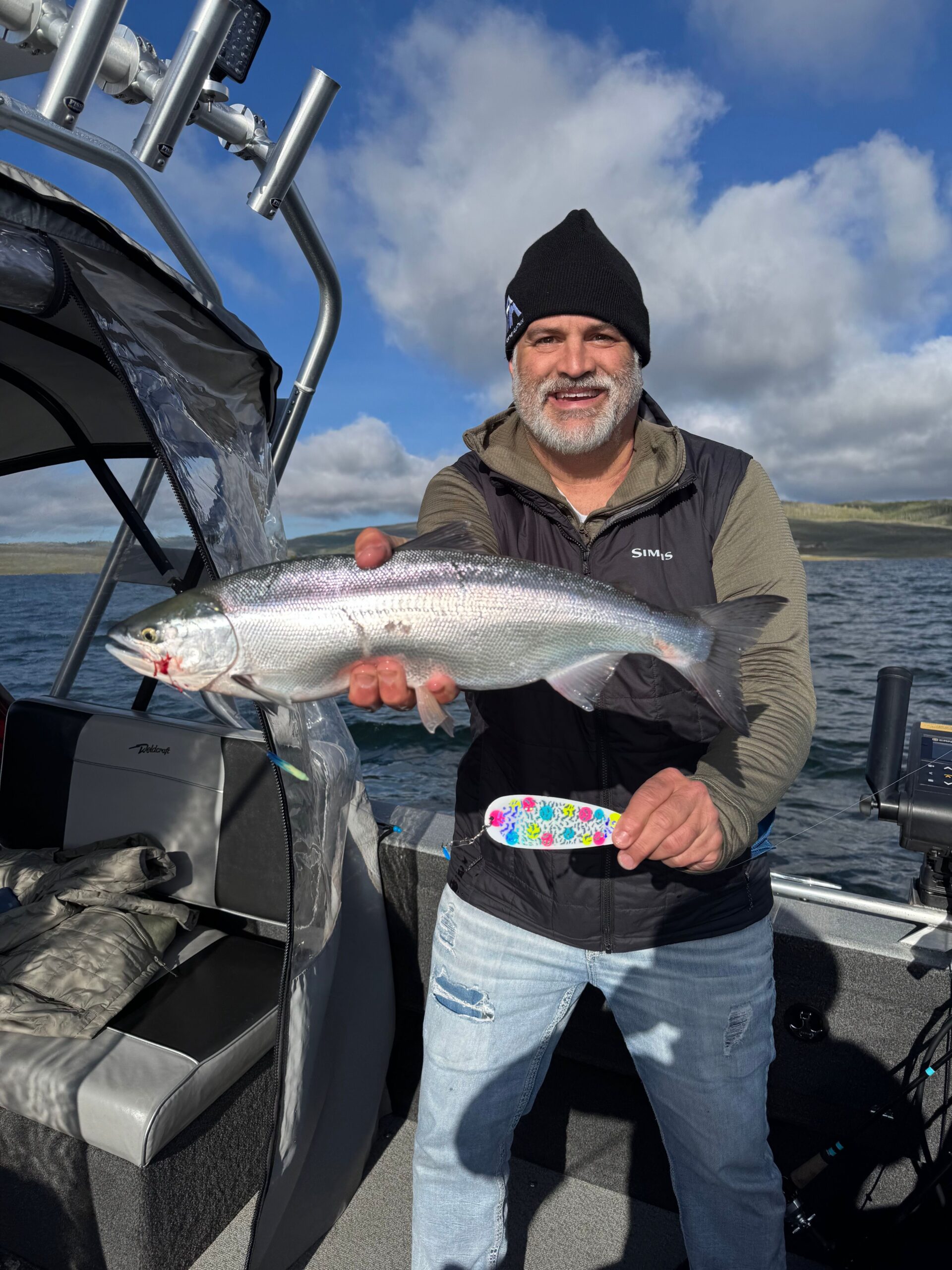
I’ve spent more than 25 years fishing for kokanee and trout, testing tackle, experimenting with presentations, and learning what works under different conditions. One thing I’ve learned is that catching kokanee isn’t about having the biggest tackle box. It’s about understanding the fish, finding their location, controlling your presentation, and learning from every bite.
In this guide, I’ll walk you through the fundamentals of kokanee fishing, including where to find fish, how deep to troll, the right speed, which dodgers and lures to use, and how to land more of the fish you hook.
My approach is simple: Find the fish. Fish the right depth. Control your speed. Give them a presentation they want.
Let’s get started.
How Do You Catch Kokanee Salmon?
The most common way to catch kokanee from a boat is to troll a small lure behind a dodger or other attractor while keeping your presentation near the depth where the fish are holding.
If you’re just getting started, here’s the basic setup I recommend:
- A 7- to 8-foot or longer kokanee rod with a soft, forgiving action
- A trolling reel with a smooth, adjustable drag
- Monofilament line or another line system that provides adequate shock absorption
- A kokanee dodger
- A small hoochie, squid, spinner, bug, or other kokanee lure
- A leader matched to your dodger and lure
- Shoe-peg corn or a suitable kokanee scent, where permitted
- A fish finder if available
- A downrigger, lead-core line, or trolling weight if you need to reach deeper fish
Start by searching open water for suspended kokanee. Once you locate fish, put your presentation at their depth and begin trolling around 1.0–1.5 mph. Watch how your dodger and lure move, and adjust your speed, depth, color, or leader length until you find a combination that produces.
There is no single depth, speed, or color that works on every lake every day. Successful kokanee anglers learn to recognize patterns and adjust to changing conditions.
1. Understand Kokanee Before You Start Fishing
Kokanee are landlocked sockeye salmon. Unlike ocean-going sockeye, they spend their entire lives in freshwater lakes and reservoirs.
They feed primarily on zooplankton, microscopic organisms that drift through the water. Because of this feeding behavior, kokanee often spend much of their time suspended in open water rather than holding tight to the bottom or shoreline structure.
That makes kokanee fishing different from fishing for bass or walleye.
Instead of always targeting rocky points, submerged timber, or the bottom, you’re often searching for schools of fish in the middle of the lake.
Kokanee also have delicate mouths. They can fight surprisingly hard, but excessive pressure from a stiff rod, tight drag, or aggressive hook set can tear a hook free.
That’s why I focus on five fundamentals:
- Location: Where are the fish holding?
- Depth: How deep is your presentation running?
- Speed: Is your tackle producing the right action?
- Presentation: Which dodger, lure, color, and leader combination is working?
- Fish handling: Can you maintain steady pressure without tearing the hook free?
Get these fundamentals right, and the rest of your tackle decisions become much easier.
2. Where to Find Kokanee
One of the biggest mistakes I see anglers make is changing lures when they haven’t found the fish.
You can have the perfect dodger and lure combination, but it won’t help if your presentation is running 20 feet above the school.
When I arrive at a lake, I start by looking for areas that are likely to hold kokanee. These can include:
- Large open-water basins
- Deep sections of the lake
- Main-lake points and underwater contours
- Areas near major creek or river mouths
- Water near dam faces
- Suspended fish showing on a fish finder
- Areas where other anglers are successfully catching kokanee
These are starting points, not guarantees. Kokanee move throughout the lake, and the best location can change with the season, water temperature, forage, and fishing pressure.
If you don’t have a fish finder, look for reliable local fishing reports and observe where anglers are catching fish. Give other boats plenty of room, and avoid assuming that every cluster of boats is targeting kokanee.
How Water Temperature Affects Kokanee
Water temperature plays an important role in kokanee location. As surface water warms, kokanee often move deeper to remain in cooler water.
During spring, you may find fish relatively close to the surface. As summer progresses, they may hold much deeper.
The thermocline can provide a useful clue. This is the transition zone between warmer surface water and colder deeper water. Kokanee may hold near or below this zone, depending on the lake’s conditions.
However, don’t assume every kokanee school will be sitting at the thermocline. Oxygen levels, forage, weather, lake structure, and local conditions can all affect where fish hold.
I treat water temperature and the thermocline as clues to investigate—not rules that determine exactly where to fish.
A Seasonal Starting Point
These depth ranges are general starting points, not universal recommendations. Your fish finder and local fishing reports should guide your final decision.
Spring
Start shallow. Kokanee may be found in roughly 5–20 feet of water, sometimes even closer to the surface. This is a good time to experiment with long-line trolling or lighter weights.
Late spring
As the water warms, try exploring approximately 15–35 feet. Pay attention to changes in fish location throughout the day.
Summer
Kokanee often move deeper as surface temperatures rise. Start exploring around 30–60 feet or deeper when conditions call for it. Let your electronics and catch results guide your adjustments.
Fall
Mature kokanee may move toward spawning tributaries, shorelines, or staging areas, depending on the fishery. Check local regulations and adjust your approach to the lake and season.
Remember, these ranges overlap because every lake is different. I’ve learned not to get locked into a particular depth simply because it worked last weekend.
3. Use Your Fish Finder to Locate Kokanee
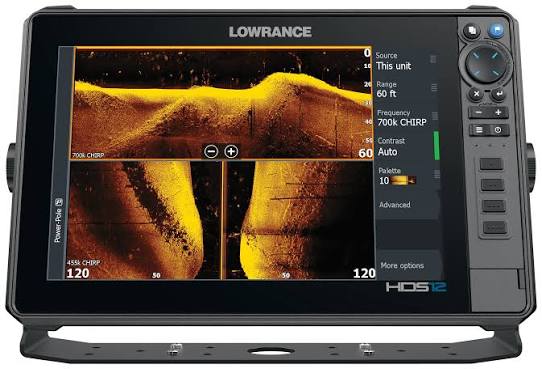
A fish finder can be one of your most useful tools for kokanee fishing. You don’t need the most expensive electronics on the market, but you do need to understand what your unit is showing you.
Kokanee may appear as individual arches, groups of arches, suspended marks, or clouds of fish on your sonar display. Their appearance depends on the electronics, settings, fish position, and other conditions.
Don’t worry about identifying every mark perfectly. Start by looking for patterns.
For example, if you repeatedly see suspended fish between 35 and 42 feet, use that information to set your trolling depth.
You might try one presentation at 35 feet and another around 40 feet. If one consistently produces bites, concentrate your efforts around that depth.
Pay Attention to Forage and Temperature
Kokanee feed primarily on zooplankton. If your electronics show a distinct forage layer and fish marks nearby, experiment with presentations above, within, and below that zone.
Water temperature can also help explain fish location. If your unit supports temperature readings, pay attention to changes as you move through the lake.
Over time, you’ll learn to connect what you see on the screen with what happens at the end of your line.
One important reminder: Keep your attention on safe navigation while using electronics. Avoid becoming so focused on your sonar that you lose awareness of other boats, changing water depth, or hazards.
4. How Deep Should You Troll for Kokanee?
This is one of the most common questions I hear, and the answer is straightforward:
Fish at the depth where the kokanee are holding.
If your fish finder shows fish around 35 feet, start there. If you’re seeing them at 15 feet, don’t keep fishing 40 feet down simply because that depth worked on your last trip.
I like to test small adjustments rather than constantly changing everything.
If fish are concentrated around 35 feet, try presentations at approximately 32, 35, and 38 feet. These are only starting points, but they can help you identify a productive depth range.
When a rod starts producing consistently, move other presentations closer to that depth and see whether the pattern holds.
Don’t Confuse Water Depth With Fishing Depth
If your boat is traveling over 100 feet of water, that doesn’t mean your lure should be 100 feet down.
Water depth describes the distance from the surface to the bottom. Fishing depth describes how far below the surface your lure is running.
Kokanee frequently suspend well above the bottom, so focus on the depth of the fish rather than the overall depth of the lake.
Also remember that your lure’s actual running depth can vary with line length, trolling speed, lure resistance, weight, and current. A line counter or downrigger helps you repeat a setup, but your system still requires some experimentation.
5. Do You Need a Downrigger to Catch Kokanee?
No. A downrigger makes precise depth control easier, especially when kokanee move deeper, but you can catch kokanee without one.
Here are three common ways to get your presentation down.
Downriggers
Downriggers are excellent for controlling depth. They allow you to lower your presentation to a target depth and return it to that depth consistently.
They’re particularly useful when fish are deep or when you want to fish multiple rods at different depths.
Lead-Core Line
Lead-core line contains a weighted core that helps your presentation sink. Many systems use color changes along the line to help estimate how much line has been released.
The color count is a starting point, not an exact depth measurement. Actual depth depends on your speed, lure resistance, line length, and setup.
Trolling Weights
Inline weights and sliding sinker systems are useful alternatives. They allow you to reach deeper fish without purchasing a downrigger.
A sliding weight system can also help keep the weight’s resistance from being transferred directly to the rod when a kokanee strikes.
Start with a manageable amount of weight and adjust until your presentation reaches the desired depth.
6. How Fast Should You Troll for Kokanee?
Speed is one of the most important variables in kokanee fishing because it affects both your dodger and your lure.
My recommendation for a beginner is to start around 1.0–1.5 mph, with approximately 1.2 mph being a useful baseline.
Some lakes, lure combinations, and conditions call for slower or faster speeds. Your goal is to find the speed that gives your particular setup the right action and produces bites.
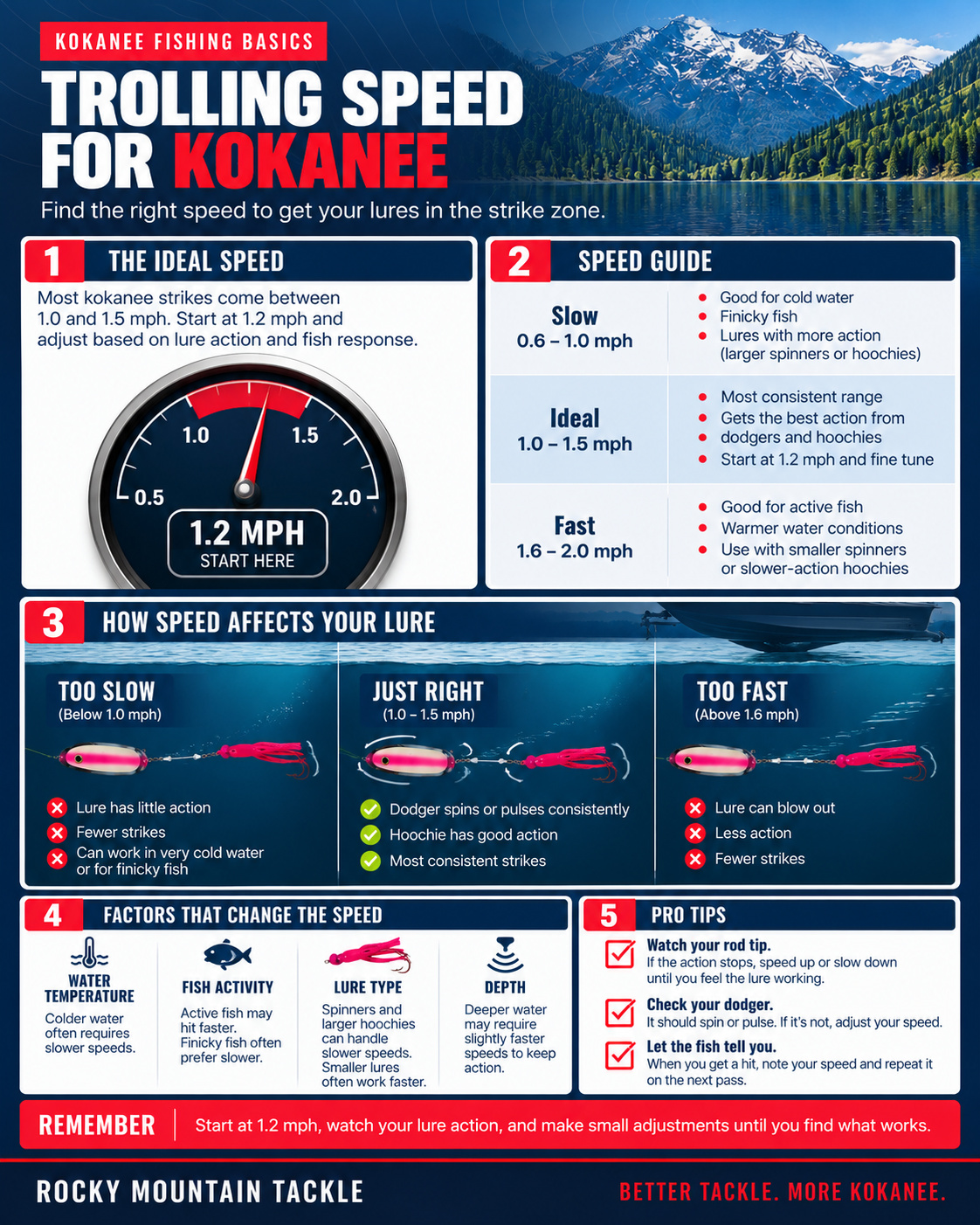
Test Your Dodger Beside the Boat
Before sending your gear out, lower your dodger beside the boat where you can see it.
Increase and decrease your speed while watching its movement.
You want the dodger to produce its intended side-to-side action. If it’s barely moving, try a little more speed. If it’s spinning or behaving differently than designed, slow down and make an adjustment.
Different dodgers are designed to behave differently, so don’t assume every model should move identically.
Once you know what your dodger should look like, you’ll have a better idea of whether your presentation is working correctly behind the boat.
Why Your GPS Speed Isn’t Always the Whole Story
Your GPS gives you speed over the ground, but current can affect the speed of water moving past your tackle.
That means your presentation can behave differently even when the GPS displays the same number.
Use GPS speed as a consistent reference, then pay attention to your dodger’s action, your lure’s behavior, and the fish’s response.
7. Use S-Turns to Change Your Presentation
Trolling in a perfectly straight line at a constant speed isn’t always the most productive approach.
Try making gradual S-turns as you work an area.
When your boat turns, the outside rods generally speed up while the inside rods slow down. Depending on your setup, those speed changes can also alter the action of your tackle.
Sometimes a small change is enough to trigger a strike.
Pay attention to which rod gets the bite. If the inside rod consistently produces, the fish may prefer the slower presentation. If the outside rod gets hit, they may respond better to the faster action.
One bite doesn’t prove a pattern, but repeated results can tell you something useful.
Experiment with gradual turns while maintaining safe control of the boat and keeping your lines clear.
8. Build a Simple Kokanee Rig
You don’t need an elaborate setup to catch kokanee. Start with a basic presentation and learn how its components work together.
A common trolling arrangement is:
Main line → Depth-control system, if needed → Dodger → Leader → Small lure
Your exact arrangement depends on whether you’re using a downrigger, a sliding weight, lead-core line, or a long-line setup.
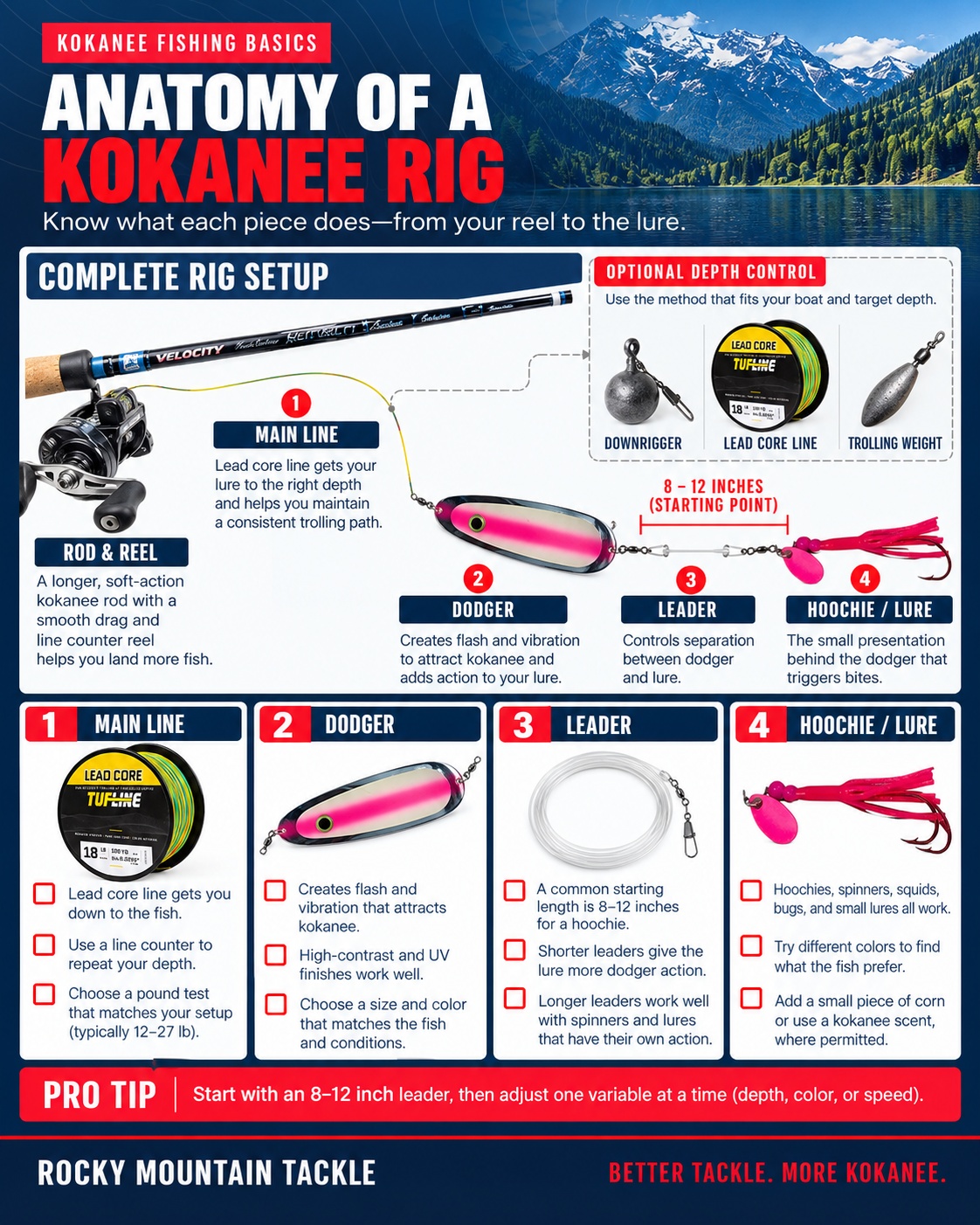
What Does a Kokanee Dodger Do?
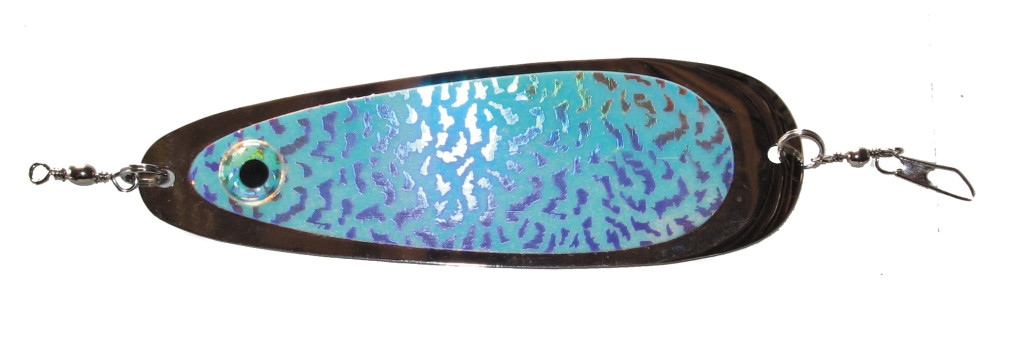
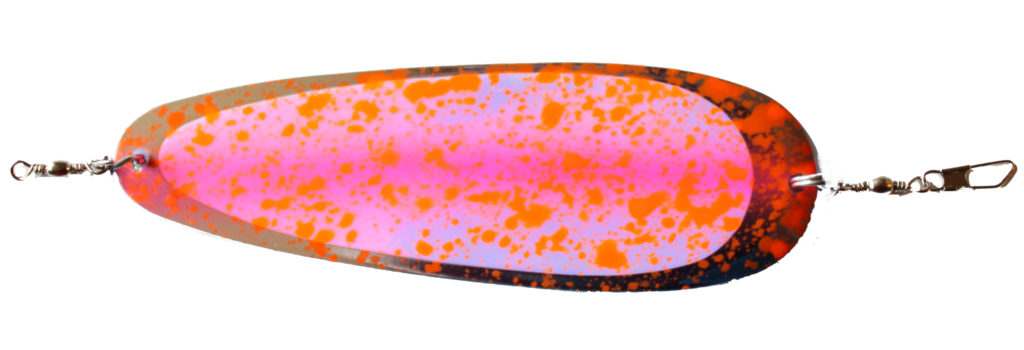
A dodger creates flash and movement that help attract attention to your presentation. Its action also influences how the trailing lure moves through the water.
A small hoochie or squid often relies heavily on the dodger to create movement. A spinner or hard lure may have more action of its own.
The goal is to create a presentation that looks and behaves correctly at your chosen trolling speed.
Choose a Dodger That Matches Your Lure
When building a rig, consider how the dodger’s action will transfer to the lure behind it.
A shorter leader can give a relatively inactive lure more of the dodger’s movement. A longer leader can give a spinner or another self-action lure more room to work.
There is no single combination that works everywhere, so start with a simple rig and adjust one variable at a time.
If you’re building your first setup, browse RMT’s kokanee dodgers and choose a size and style appropriate for the lure you plan to fish.
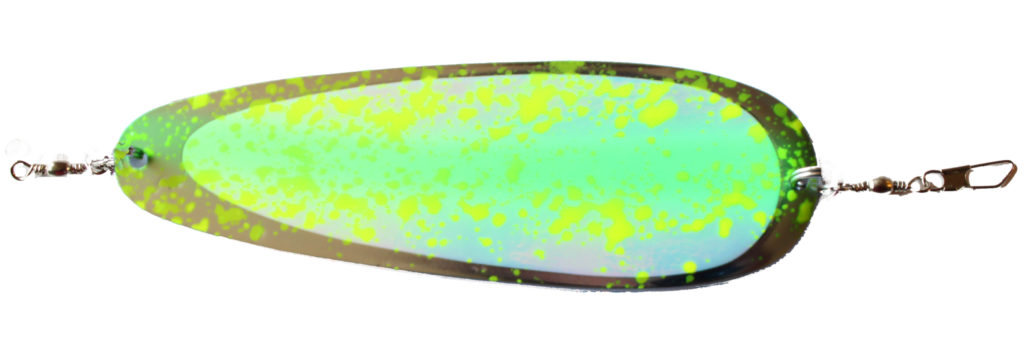
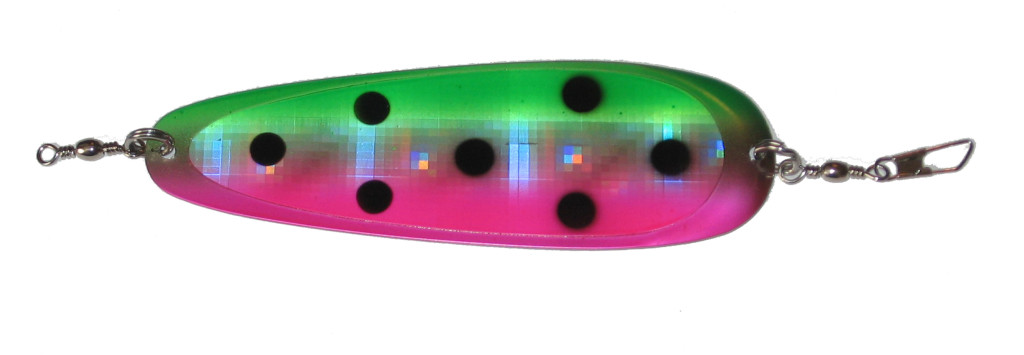
Top Kokanee Dodgers from Rocky Mountain Tackle
9. What Lure Should You Use for Kokanee?
There isn’t one best kokanee lure for every lake and every day. I recommend carrying a few different presentation styles so you can adjust when the fish aren’t responding.
Hoochies and Squids
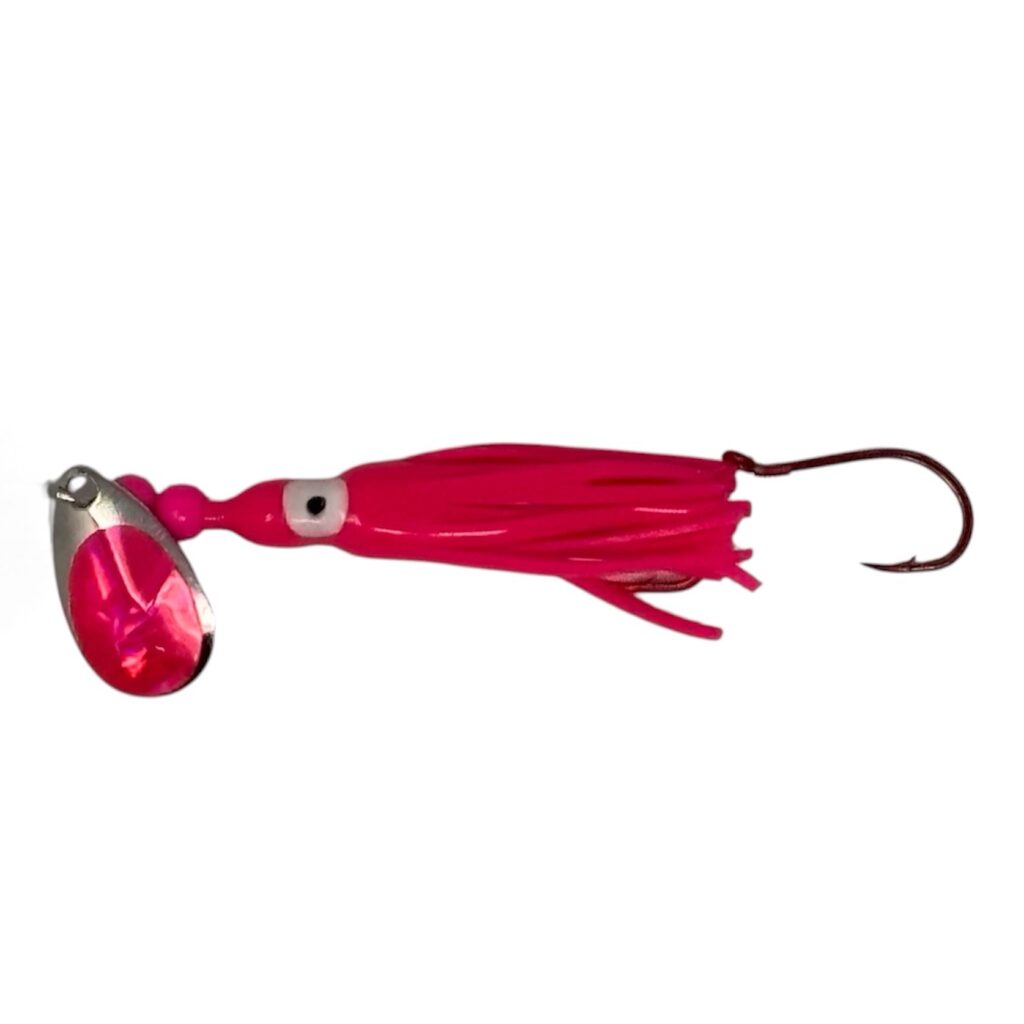
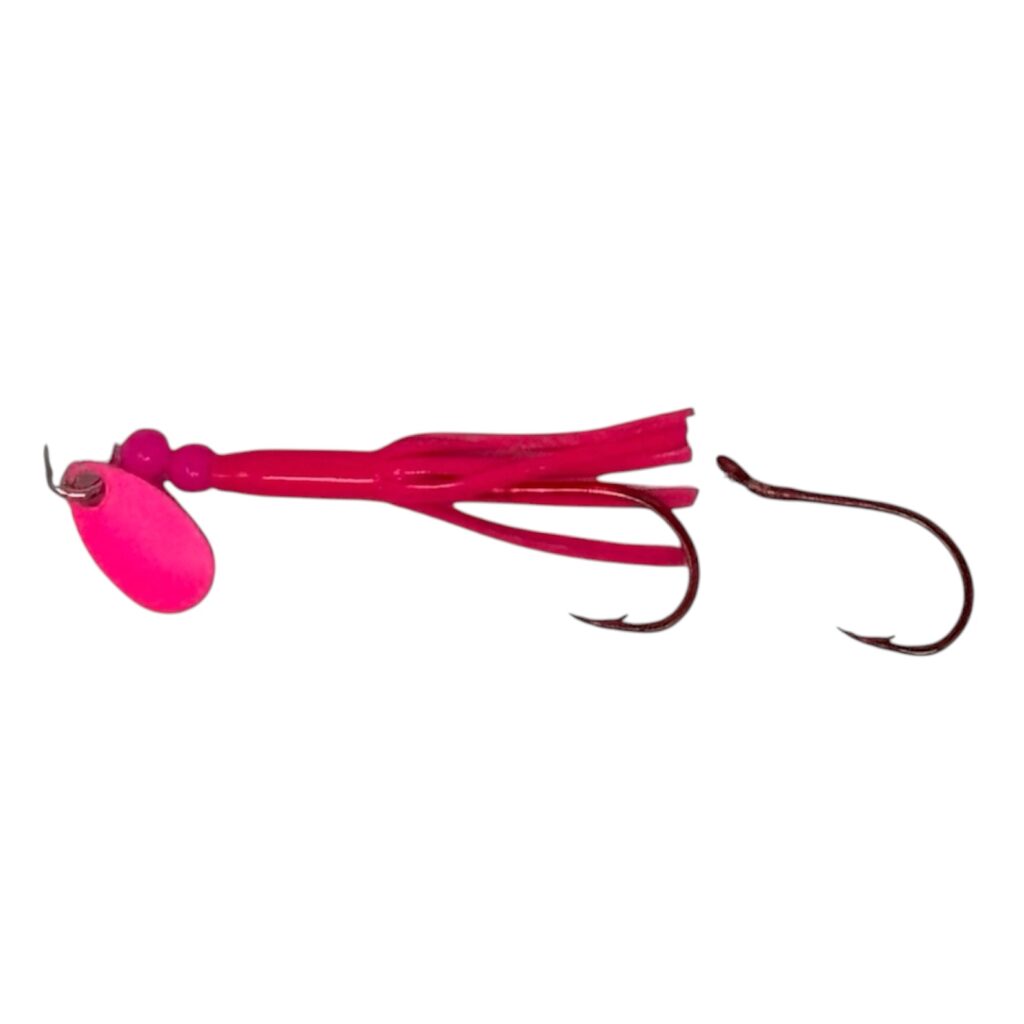
Hoochies and small squid-style lures are popular kokanee options, particularly when fished behind a dodger.
Because they generally have less independent action than a spinner, leader length and dodger movement can make a noticeable difference.
Start with a simple combination and experiment with color and leader length if the fish aren’t responding.
Top Kokanee Squids and Hoochies from Rocky Mountain Tackle
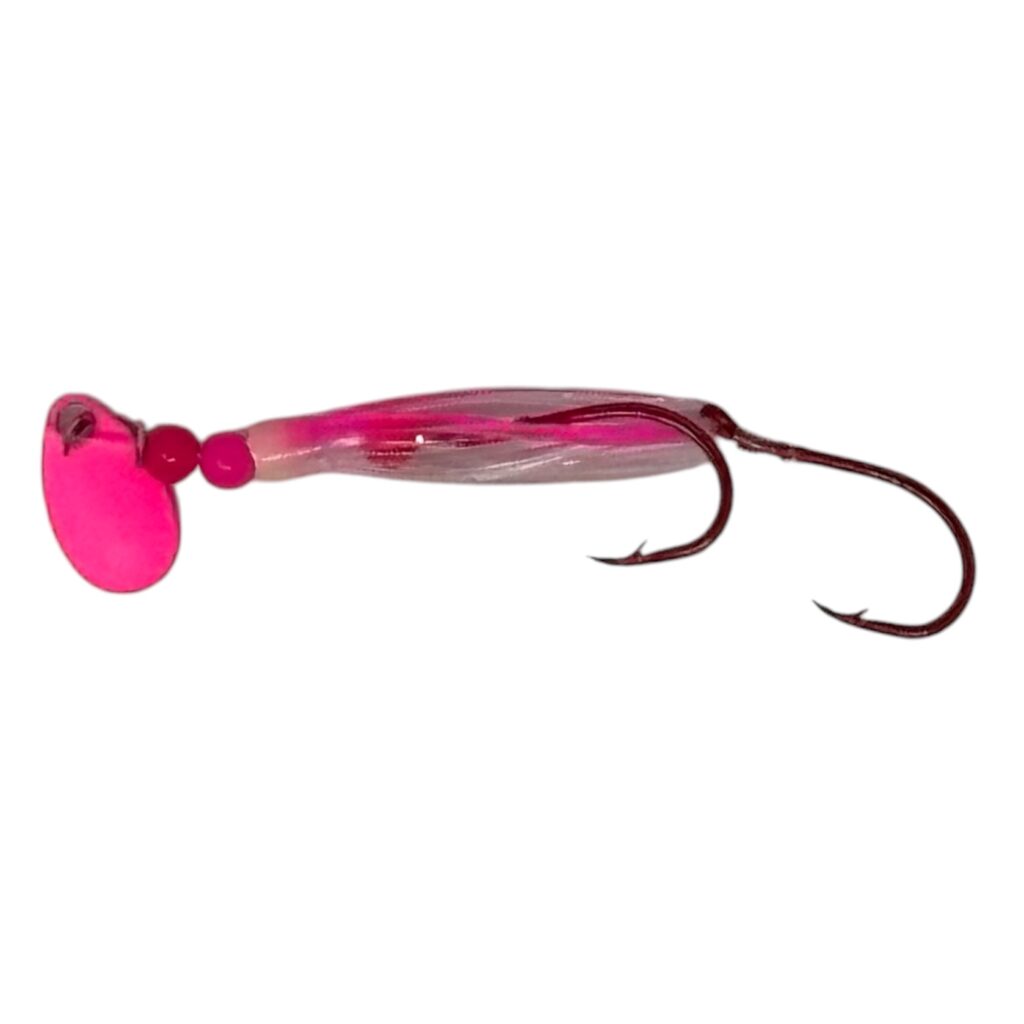
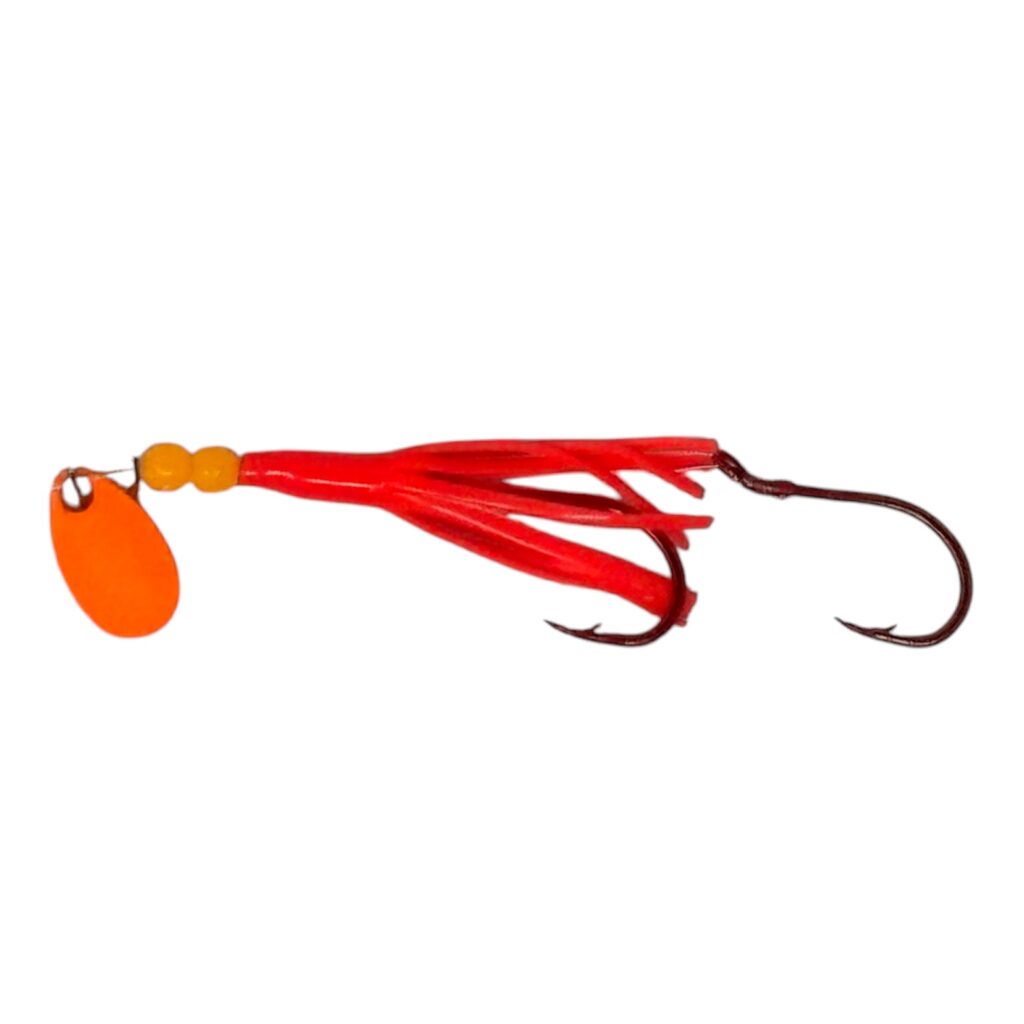
Explore RMT’s Signature Squid Selection for different profiles and color options.
Spinners
Spinners provide flash and vibration and offer a different presentation from a hoochie.
They can be a useful option when you want more independent movement from the lure. Some anglers also tip their spinner hooks with corn or another permitted bait.
Top Kokanee Spinners from Rocky Mountain Tackle
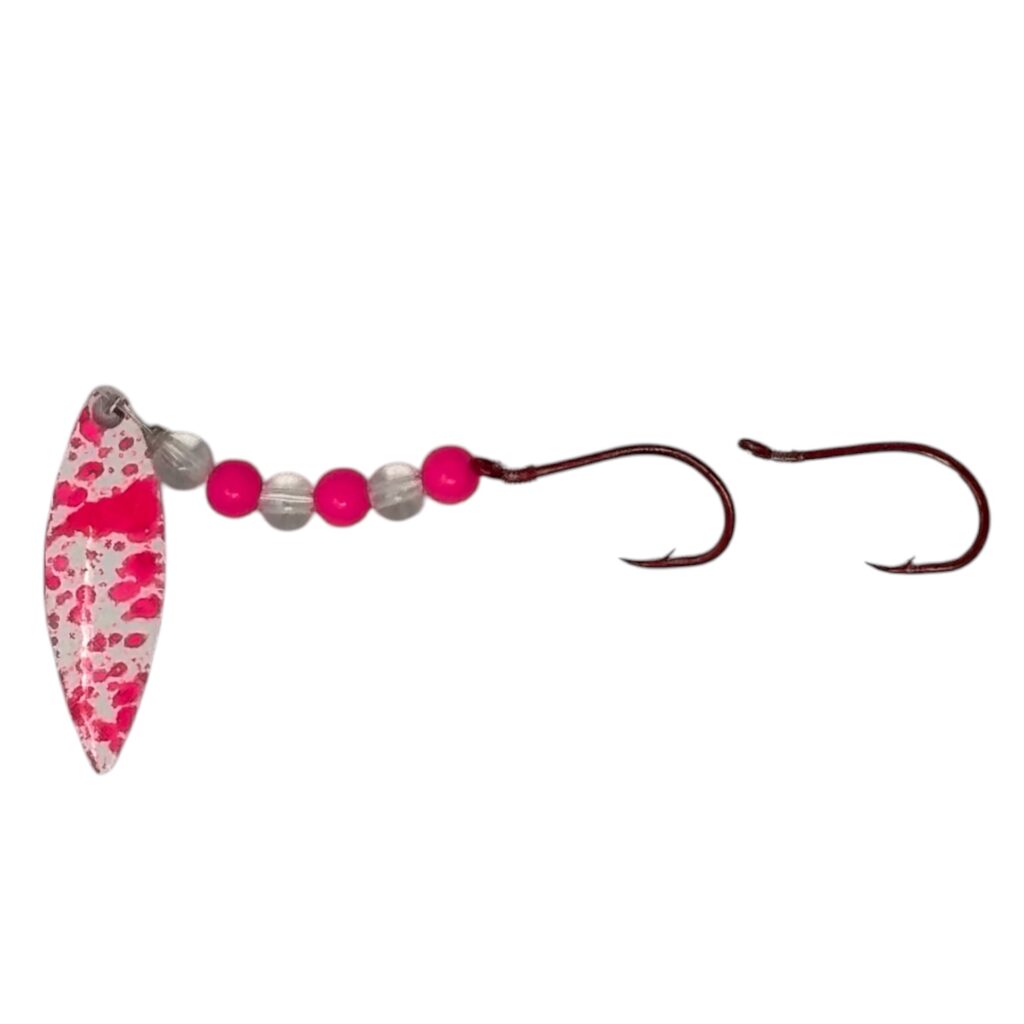
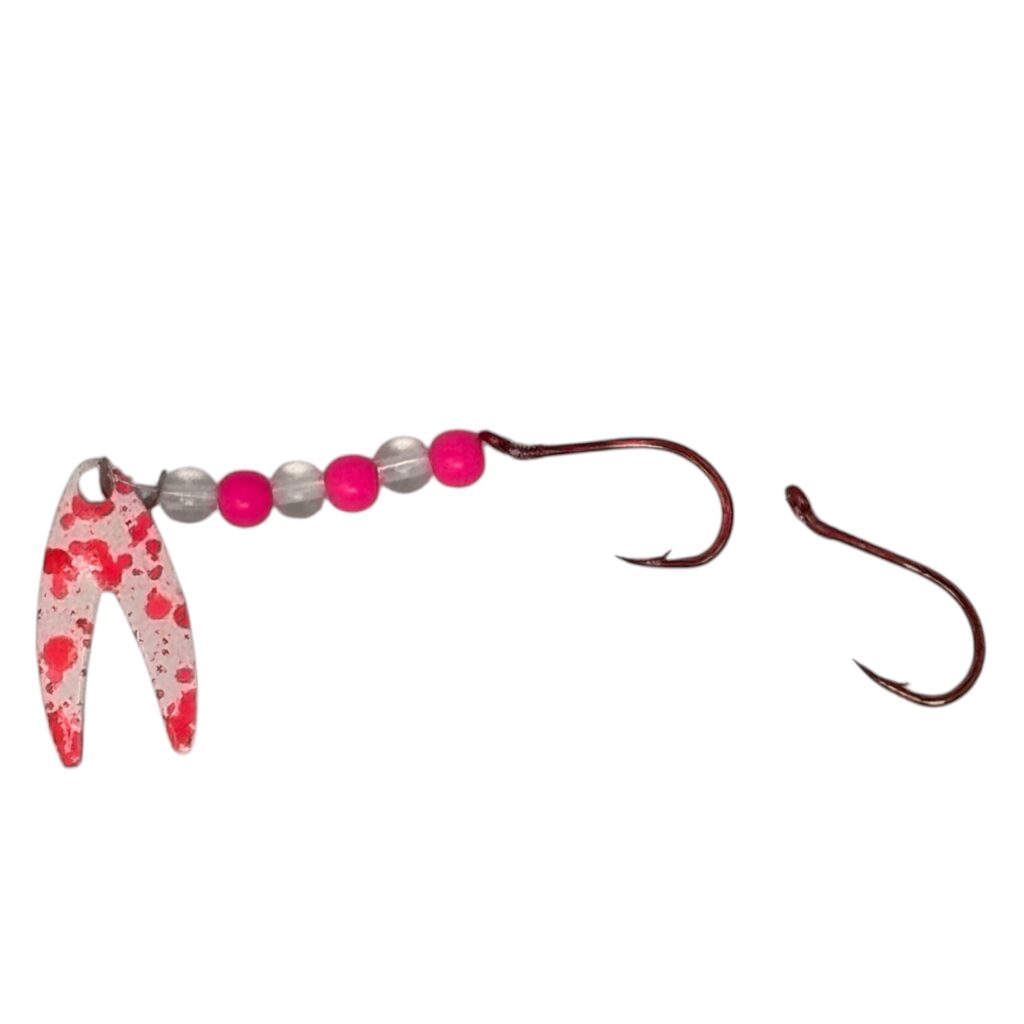
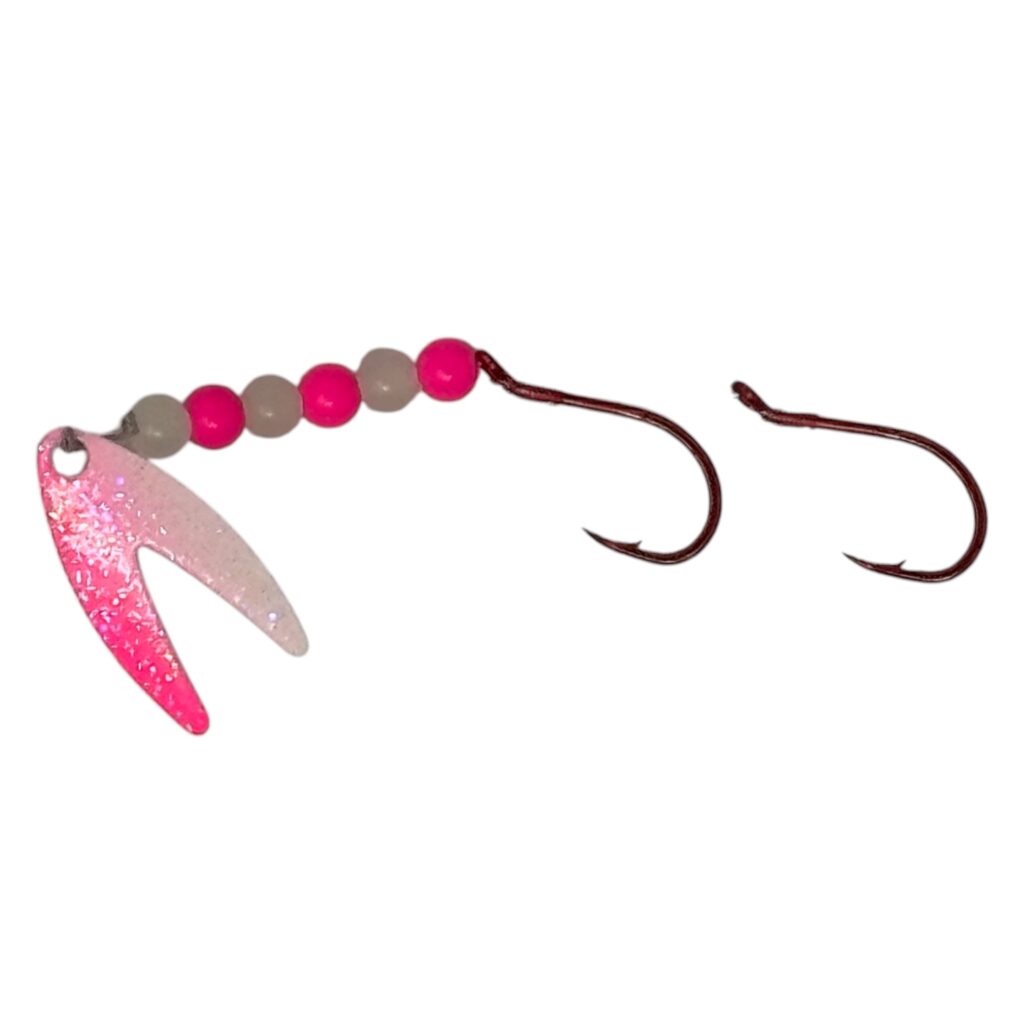
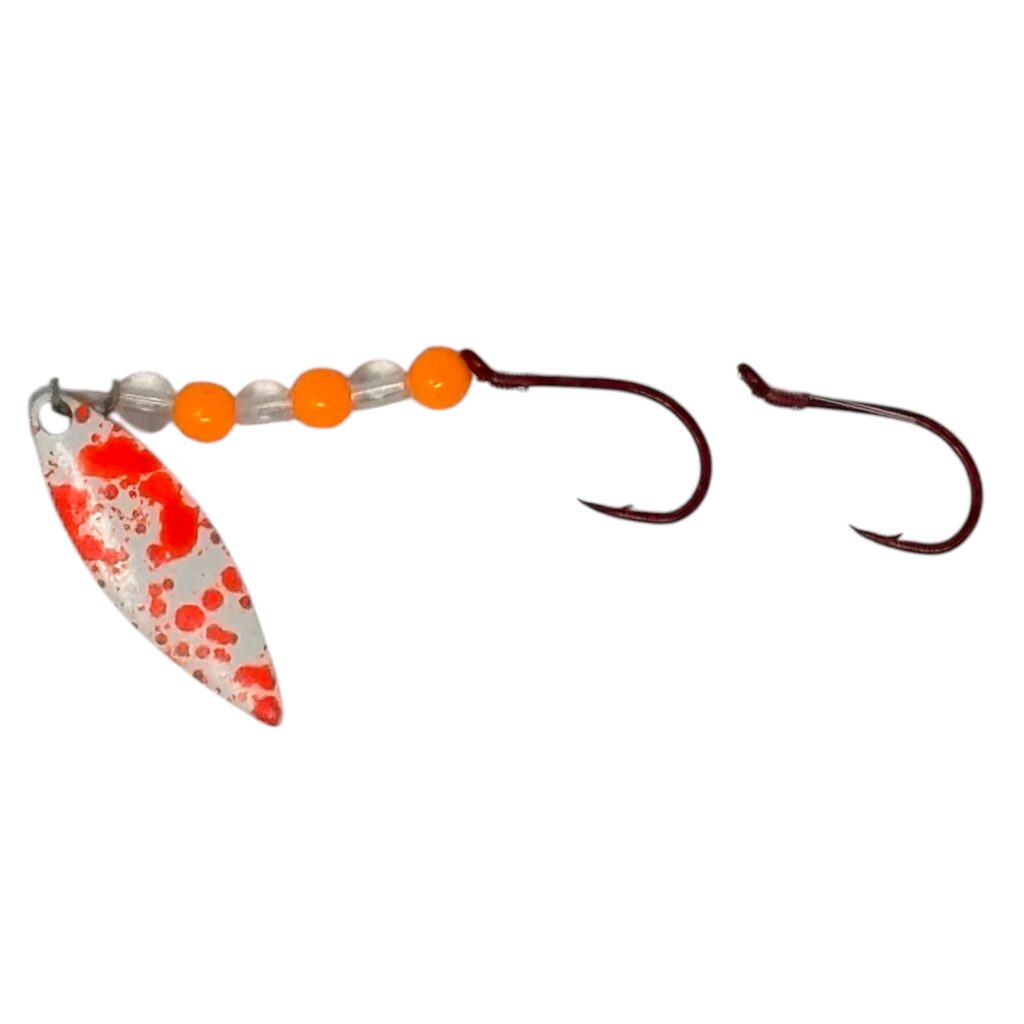
Explore RMT’s Signature Spinner Selection for different profiles and color options.
Small Hard Lures and Spoons
Small hard-bodied lures and spoons provide their own action. Depending on the fishery, they can be productive alternatives to a hoochie or spinner.
They’re worth carrying when you want to experiment with a different profile or action.
Top Kokanee Hard Body Lures Rocky Mountain Tackle
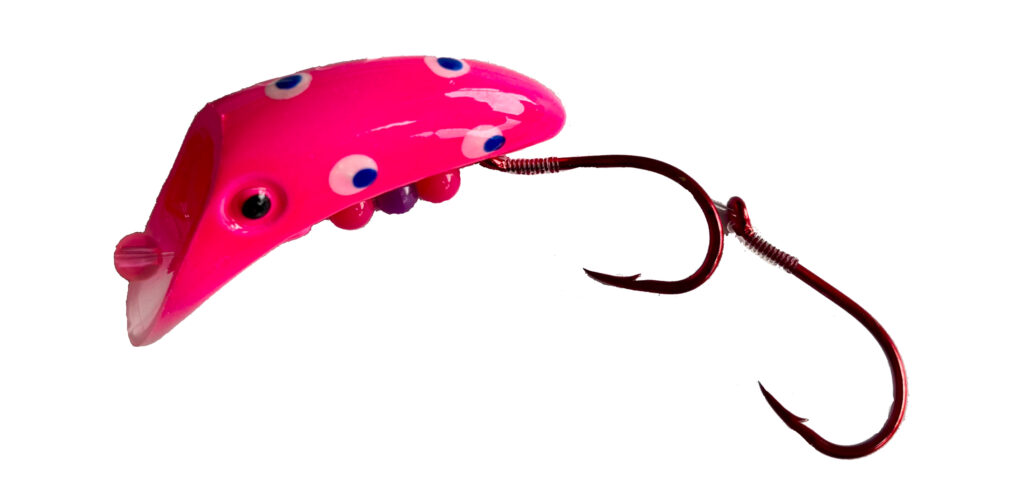
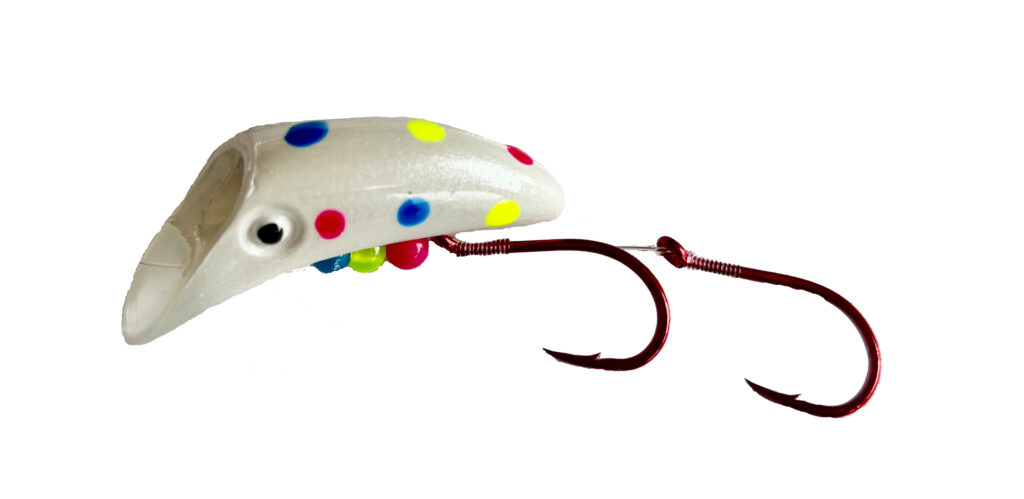
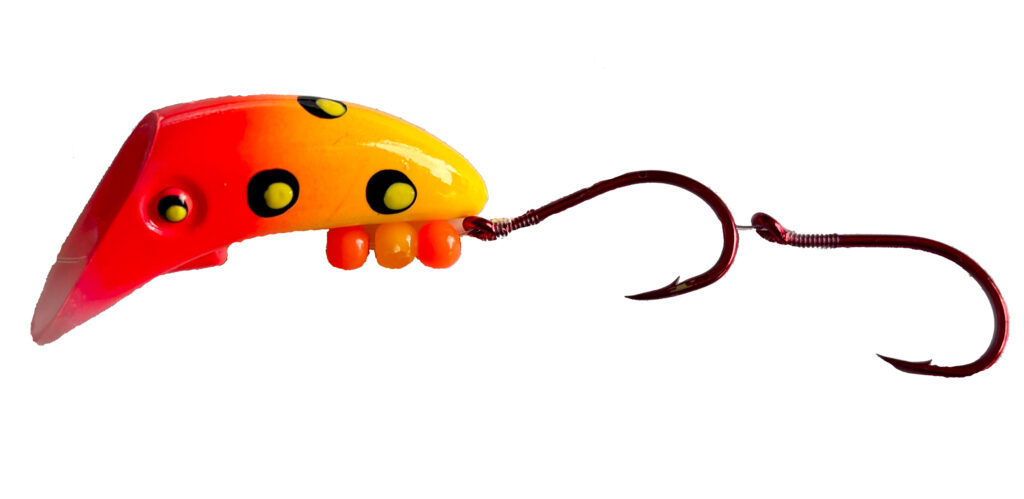
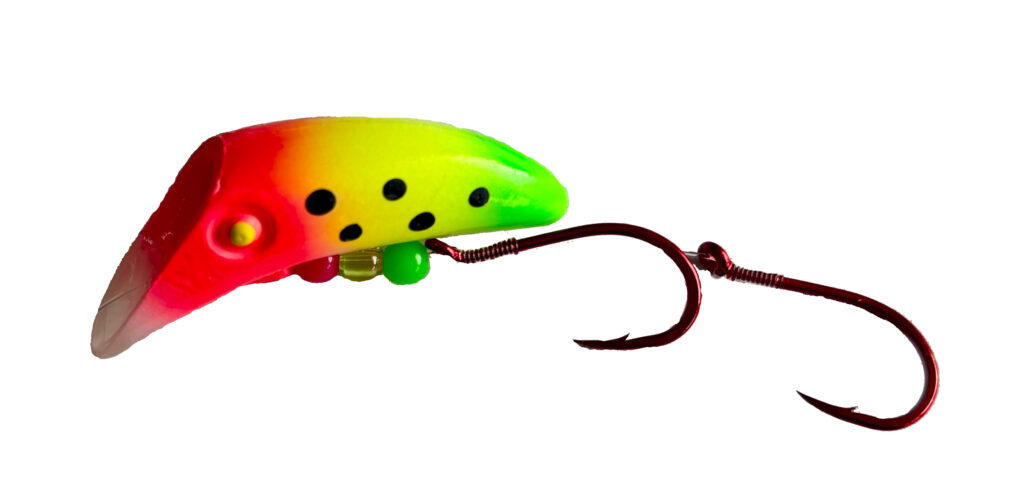
Explore RMT’s Top Devil Selection for different profiles and color options.
Bugs and Micro-Flies
Small bugs and flies offer a compact presentation that can be useful when fish are selective.
Try them when larger or more aggressive presentations aren’t producing.
The important thing is to avoid changing lures randomly. Start with a reliable option, then switch presentation styles when you have a reason to test something different.
10. How Long Should Your Kokanee Leader Be?
Leader length affects how much action your lure receives from the dodger and how freely it moves through the water.
For a beginner, I recommend treating leader length as an adjustment rather than a fixed rule.
A useful starting framework is:
- Small hoochies and squid-style lures: Try a relatively short leader, often around 8–12 inches.
- Spinners: Start around 10–18 inches, adjusting to the action of your particular setup.
- Small bugs and flies: Try a shorter leader when you want the dodger to influence the presentation.
- Hard lures and spoons: Experiment with a longer leader when the lure benefits from more freedom of movement.
These are starting ranges, not universal specifications. Dodger size, lure design, and the action you want all influence the best length.
Idaho Fish and Game recommends shorter leaders for lures with little built-in action, such as hoochies, and longer leaders for spinners and other lures with independent action.
If your hoochie looks lifeless, try shortening the leader. If the lure looks too aggressive or is being pulled unnaturally, try adding a little length.
Make small adjustments and observe the result.
11. What Color Is Best for Kokanee?
Color is one of the most debated topics in kokanee fishing. I’ve learned to keep several options available rather than relying on one color all season.
Start with these color families:
Pink: A foundational color to keep in your tackle box.
Orange: A bright option worth testing when you want a warmer presentation.
Chartreuse: Useful when you want a strong contrast against the surrounding water.
Purple: A good alternative when fish respond better to a darker or different profile.
UV finishes: Can provide useful visual contrast under suitable lighting conditions.
Glow: Worth testing in deeper or low-light situations. Glow products need to be charged before use, and results vary with conditions.
Water clarity, sunlight, depth, season, fishing pressure, and the individual lake can all influence which colors work best.
How I Approach Color Changes
If I’m getting bites on pink, I don’t immediately switch to another color just because I have it in the box.
Instead, I look for a reason to change.
If fish are showing on sonar but aren’t striking, I may try a contrasting color. If one rod is producing while another isn’t, I might keep the productive presentation in place and change only the other rod’s lure color.
The goal is to discover what the fish prefer under the current conditions—not to guess which color should work.
You can start with a few complementary colors and build your selection as you gain experience.
12. Should You Use Corn or Scent for Kokanee?
Many kokanee anglers tip their hooks with white shoe-peg corn. Some also use other bait options or fish-attracting scents.
Corn can add scent, taste, and texture to your presentation. You don’t need to overload the hook; start with a small piece and make sure the lure still moves correctly.
Scent is another variable worth testing. Common options include anise, garlic, krill, herring, and kokanee-specific formulas.
I treat scent as an enhancement to a well-presented lure, not a replacement for finding fish.
If your presentation is 20 feet above the school, adding more scent probably won’t solve the problem.
Start with a scent you trust, use it consistently, and experiment when you have a reason to change. Always check local regulations regarding bait and scent use.
13. What Rod and Reel Should You Use for Kokanee?
Kokanee have delicate mouths, so the rod you use can make a real difference in how many fish you land.
For most beginner trolling setups, look for:
- A rod approximately 7–8 feet or longer
- Light or ultralight power, depending on the weight you’re trolling
- Moderate or slow action
- A blank that bends progressively and absorbs sudden runs
- A reel with a smooth, adjustable drag
A soft-action rod acts like a shock absorber. It helps cushion the sudden runs and head shakes that can tear a hook free.
If you’re trolling with heavier weights, choose a rod with enough backbone to handle that setup while still providing appropriate shock absorption.
A line-counter reel is also useful because it helps you repeat the amount of line you’ve released. Consistency makes it easier to reproduce a productive presentation.
You don’t need to purchase every specialized piece of equipment before your first trip. Start with a functional setup and upgrade as your fishing skills develop.
14. What Fishing Line Should You Use?
Monofilament is an excellent starting point for kokanee trolling because its stretch helps absorb sudden movements.
Braided line is another option. It offers high strength for its diameter and very little stretch, but that lack of stretch means the rest of your setup needs to absorb more of the fish’s movement.
If you use braid, pay particular attention to your rod action, drag setting, leader system, and any shock-absorbing components appropriate for your rig.
There is no single line choice that works for every angler. What matters most is that the entire system works together to maintain steady pressure without tearing the hook free.
For beginners, a straightforward monofilament setup can make it easier to learn how to fight kokanee successfully.
15. How to Fight and Land a Kokanee
Hooking a kokanee is exciting, but landing it can be the hardest part.
When a fish strikes, resist the urge to set the hook aggressively like you might when bass fishing.
Instead, smoothly pick up the rod and begin reeling while maintaining steady pressure. Let the rod load and allow the drag to do its job.
Keep the line tight without overpowering the fish.
Kokanee can make sudden runs and head shakes, particularly near the boat. This is where an overly tight drag or a stiff rod can cause problems.
Get Your Landing Net Ready
A soft-mesh or rubberized landing net is a useful tool.
As the fish approaches:
- Maintain steady pressure.
- Keep the fish in the water as long as practical.
- Position the net in the water ahead of the fish.
- Guide the fish’s head toward the net.
- Lift smoothly once the fish is over the net.
Avoid chasing the fish around the surface with repeated, frantic net attempts.
One controlled scoop is much better than several rushed attempts.
If you plan to keep your catch, handle the fish promptly and keep it properly chilled. Follow your local regulations regarding harvest, limits, and fish handling.
16. Your First Kokanee Fishing Trip: A Simple Game Plan
If you’re heading out for your first kokanee trip, here’s the approach I’d recommend.
Before You Launch
Check the weather, local fishing reports, lake conditions, and current fishing regulations.
Make sure your tackle is ready, your drag is adjusted, and your landing net is accessible.
If possible, rig two rods with different presentations. For example:
- Rod 1: A pink hoochie behind a dodger.
- Rod 2: An orange or chartreuse spinner behind a dodger.
This gives you two presentations to compare without changing everything at once.
During the First 30 Minutes
Spend time learning where the fish are holding rather than immediately changing lures.
Watch your fish finder for suspended marks and consistent depth ranges. Look for patterns in the areas where you see fish, and use local reports to help narrow your search.
If you don’t have electronics, use seasonal information, local reports, and observations of other anglers to choose a starting area.
Establish Your Starting Depth
Begin with a depth that matches what you’re seeing on sonar or what local conditions suggest.
If fish are marking around 40 feet, try a presentation near that depth and another slightly above or below it.
Don’t spread your gear randomly through the water column if you already have useful information about where the fish are.
Start Around 1.2 MPH
Begin around 1.2 mph and watch your dodger’s action.
If you’re not getting bites, try modest adjustments, such as 1.0 mph or 1.4 mph, and pay attention to the result.
Remember that your boat speed, current, and tackle design all affect presentation.
Make Gradual S-Turns
Work the area with gentle turns. Watch which rods get bites and whether the speed changes appear to affect your results.
If you notice a repeatable pattern, try to reproduce it.
Most importantly, keep track of what works so you can make informed adjustments throughout the day.
17. What If You’re Marking Kokanee but Not Catching Them?
If your fish finder shows fish but you’re not getting bites, don’t change everything at once.
Work through the variables systematically.
First, adjust depth.
Move your presentation a few feet above or below the depth where you’re marking fish.
Second, adjust speed.
Try moving approximately 0.2 mph faster or slower. Watch your dodger’s action and see whether the change produces a response.
Third, change color.
If you’re using pink, test orange, chartreuse, purple, UV, or glow.
Fourth, change lure style.
Switch from a hoochie to a spinner, or try a small hard lure if your current presentation isn’t producing.
Fifth, adjust leader length.
Shorten or lengthen the leader to change how the lure responds to the dodger.
Change one variable at a time whenever possible. That way, if you start catching fish, you’ll have a better idea of what made the difference.
Also remember that sonar marks are not always kokanee. If repeated passes produce no response, reconsider your location or whether the fish you’re seeing are the species you’re targeting.
18. What If You’re Getting Bites but Losing Fish?
If you’re hooking kokanee but losing them before they reach the boat, focus on your equipment and fish-fighting technique.
Check these items:
- Rod action: A stiff rod may not absorb sudden movements well.
- Drag tension: A drag that’s too tight can pull hooks free.
- Line system: Make sure you have adequate shock absorption.
- Hooks: Check for damage, dull points, or poor rigging.
- Leader strength: Inspect for abrasion or damage.
- Netting technique: Keep the fish under control and make one smooth attempt.
- Hook-set pressure: Avoid aggressive hook sets.
The biggest lesson is to stop trying to overpower the fish.
Keep steady pressure, let the rod bend, and allow the drag to work. Losing a few kokanee is part of learning, but a well-balanced setup and controlled technique can improve your landing success.
19. Common Kokanee Fishing Mistakes
If you’re struggling to catch kokanee, review these common mistakes.
Fishing at the wrong depth. Your presentation needs to be near the fish. Use sonar, seasonal patterns, and catch results to guide your depth.
Trolling too fast. Start around 1.0–1.5 mph and adjust to your lure and dodger action.
Changing too many things at once. Test one variable so you can identify what actually works.
Using a rod that’s too stiff. Kokanee have delicate mouths, and a forgiving rod helps absorb sudden movements.
Setting the hook too aggressively. Smoothly pick up the rod and reel while maintaining steady pressure.
Trolling in a straight line all day. Gradual S-turns can change presentation speed and help reveal what the fish prefer.
Ignoring what the fish are telling you. Pay attention to depth, speed, color, leader length, and the rods that get bites.
Assuming yesterday’s pattern will work today. Conditions change, and kokanee move. Treat yesterday’s success as a starting point, not a guarantee.
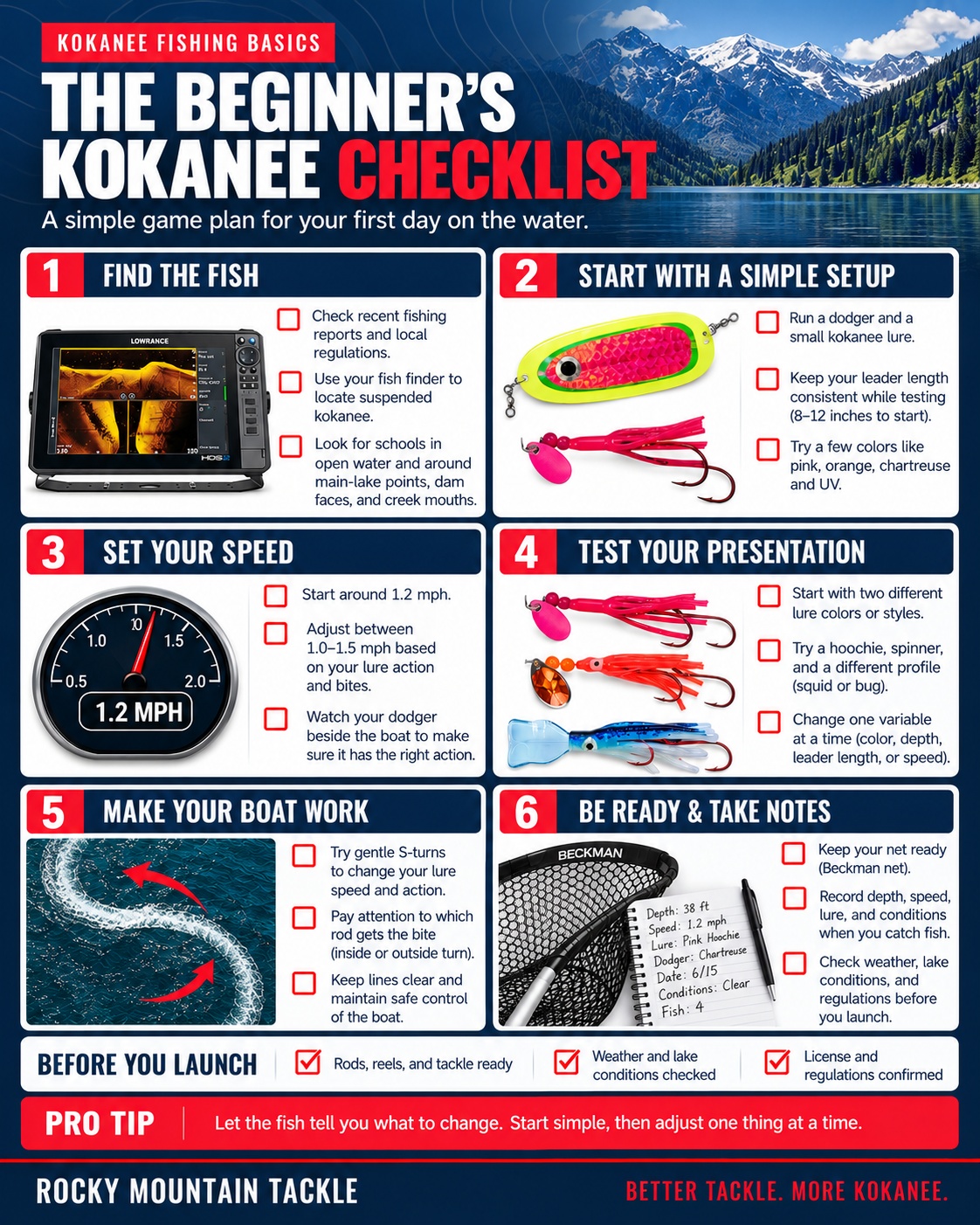
20. Beginner’s Kokanee Tackle Checklist
You don’t need a garage full of equipment to get started. Focus on the essentials and expand your selection as you learn.
Rod and Reel
- A soft-action kokanee rod
- A trolling reel with a smooth drag
- A line-counter reel if desired
Line and Terminal Tackle
- Monofilament or another suitable trolling line
- Leaders in several lengths
- Quality swivels
- Appropriate hooks
- Shock-absorbing components when needed
Dodgers and Lures
- A few kokanee dodgers
- Small hoochies or squid-style lures
- Spinners
- A few alternative lure styles
- Several complementary colors
Depth Control
Choose the method that fits your boat and budget:
- Downrigger
- Lead-core line
- Trolling weights or a suitable sliding-weight system
Bait and Accessories
- Shoe-peg corn or another permitted bait
- Kokanee scent
- Fish finder, if available
- Quality landing net
- Cooler with plenty of ice
You don’t need every color or every lure in the RMT catalog. Start with a few combinations, learn how they work, and expand your tackle box based on your experience.
21. My Recommended First Kokanee Setup
If I were helping a beginner put together a first trolling setup, I’d keep it straightforward.
Start with:
- A soft-action kokanee rod
- A trolling reel with a smooth drag
- Suitable line with adequate shock absorption
- A kokanee dodger
- A small hoochie or squid-style lure
- A leader matched to the dodger and lure
- A small piece of shoe-peg corn, where permitted
For the initial presentation, I’d start with a pink or UV hoochie behind a dodger.
Set your trolling speed around 1.2 mph, then adjust based on the action of your tackle and the fish’s response. Use your fish finder to locate suspended kokanee and get your lure to their depth.
If you’re building your first tackle collection, RMT’s Kokanee Special Kit is one option to explore. It includes a selection of dodgers, spinners, squids, and scent, providing several presentation styles to experiment with.
This setup won’t guarantee a fish. Nothing does. But it gives you a practical starting point and helps you learn the fundamentals without overcomplicating your first trip.
22. Keep a Kokanee Fishing Log
One of the fastest ways to become a better kokanee angler is to record what happens on the water.
Every time you catch a fish, note:
- Lake and location
- Date and time
- Weather conditions
- Water temperature, if available
- Fishing depth
- Trolling speed
- Direction of travel or whether you were turning
- Dodger and lure
- Color
- Leader length
- Bait or scent
- Number of fish caught
Over time, these details can reveal patterns that are difficult to remember from one trip to the next.
You might discover that a particular color combination works well at a certain depth, or that a modest speed change consistently produces more bites.
The value isn’t in finding a magic formula that works forever. It’s in learning how to identify productive patterns and reproduce them when conditions are similar.
23. How to Become a Better Kokanee Angler
The best way to improve isn’t necessarily to buy more tackle. It’s to become more deliberate about how you fish.
When you catch a kokanee, ask yourself:
- What depth was I fishing?
- How fast was the boat moving?
- Was I turning or traveling straight?
- Which dodger and lure was I using?
- What was the leader length?
- Did I use corn or scent?
- What were the weather and water conditions?
If you catch another fish under similar conditions, pay attention.
One fish gives you a clue. Several fish caught under similar conditions may reveal a pattern worth repeating.
As your experience grows, you’ll become better at separating meaningful patterns from random results. You’ll also develop a better understanding of how your tackle behaves at different speeds and depths.
That’s when kokanee fishing starts to become more predictable.
Frequently Asked Questions About Catching Kokanee Salmon
What is the best way to catch kokanee salmon?
Trolling a small lure behind a dodger or other attractor is one of the most common ways to catch kokanee from a boat. Finding the fish, controlling depth, and maintaining an effective trolling speed are key parts of the approach.
What is the best bait for kokanee?
Shoe-peg corn is a popular choice for tipping kokanee hooks. Some anglers also use other permitted baits and kokanee scents. Experiment with a small amount and make sure your lure still moves correctly.
What color works best for kokanee?
Pink is a popular starting color, but orange, chartreuse, purple, UV, and glow patterns can all produce. The best choice depends on conditions, the lake, depth, and what the fish respond to that day.
How deep should I fish for kokanee?
There is no universal depth. Kokanee may be shallow in spring and move deeper as water temperatures increase. Use your fish finder and local fishing reports to identify a starting depth, then adjust based on results.
How fast should I troll for kokanee?
A good starting range is approximately 1.0–1.5 mph, with around 1.2 mph being a useful baseline. Adjust your speed based on your dodger’s action, lure behavior, and the fish’s response.
Do I need a downrigger to catch kokanee?
No. Downriggers make precise depth control easier, especially in deeper water, but you can also use lead-core line, trolling weights, and other depth-control systems.
What rod should I use for kokanee?
A longer rod with a soft, forgiving action is a good choice for trolling. Kokanee have delicate mouths, so a rod that absorbs sudden runs and head shakes can help prevent lost fish.
Why do I keep losing kokanee near the boat?
Common causes include a stiff rod, overly tight drag, aggressive hook sets, insufficient shock absorption, damaged hooks, and poor netting technique. Maintain steady pressure and let the rod and drag do their job.
Can you catch kokanee without a fish finder?
Yes. A fish finder makes locating suspended schools much easier, but it isn’t required. Use seasonal patterns, local fishing reports, and observations of successful anglers to identify promising areas.
What is the best time of year to catch kokanee?
Kokanee can be caught throughout much of the open-water season, depending on the lake. Spring and early summer can offer good opportunities, while summer fishing may require targeting deeper water. Check local regulations and current fishing information before heading out.
Can you catch kokanee from shore?
It is possible in some fisheries and during certain conditions, but kokanee often suspend in open water, making them more accessible to anglers fishing from a boat or other flotation device. Local conditions and fish behavior determine the best approach.
Your Kokanee Fishing Checklist
Before leaving the dock, review this quick checklist.
LOCATION
- Have I checked recent fishing reports?
- Do I know where kokanee are likely to be holding?
- What does my fish finder show?
DEPTH
- What depth are the fish holding?
- Can I get my presentation into that zone?
- Am I recording the depth of productive catches?
PRESENTATION
- Is my dodger producing the intended action?
- Is my lure running correctly?
- Have I considered changing leader length?
SPEED
- Am I starting around 1.0–1.5 mph?
- Have I tested slightly faster and slower speeds?
- Have I tried gradual S-turns?
COLOR AND LURE
- Do I have pink and a contrasting color?
- Do I have a UV or glow option?
- Have I tested a different lure style when necessary?
LANDING FISH
- Is my drag set appropriately?
- Am I using a forgiving rod?
- Am I maintaining steady pressure?
- Is my landing net ready?
Better Tackle. More Kokanee.
Kokanee fishing can seem complicated when you’re first getting started. There are plenty of tackle choices, technical details, and changing conditions to learn.
But success begins with a few fundamentals: find the fish, fish the right depth, control your speed, choose a presentation that works, and pay attention to what the fish tell you.
You don’t need to know everything before your next trip. Start with a simple setup, experiment with a few presentations, and learn from every fish you catch.
At Rocky Mountain Tackle, kokanee fishing is more than another tackle category. It’s what we do. For more than 25 years, we’ve focused on fishing, testing, and developing tackle with the goal of helping anglers succeed on the water.
Our philosophy is straightforward: Field tested. Kokanee tested. Fisherman tested.
We’re building RMT into a resource where anglers of every skill level can learn how to find kokanee, choose the right tackle, rig their presentations, and become more confident on the water.
When you’re ready to build your setup, explore our kokanee dodgers, hoochies, and Kokanee Special Kit.
Keep learning, keep experimenting, and enjoy the time you spend on the water.
About the Author
Jared Johnson — Founder • Kokanee Fisherman • Product Innovator
Jared Johnson is the founder of Rocky Mountain Tackle and has more than 25 years of experience fishing for kokanee and trout. Raised in Utah, Jared developed his passion for fishing on Western lakes and reservoirs. Today, he continues to focus on tackle innovation, product testing, and helping anglers become more successful on the water.